Daphne continues...
During this period, I have taken responsibility for managing the land and have made it available to and worked with individuals and institutions interested in the environment. These include a Hedgerow Survey for the Lower Mole Countryside Management Project carried out by local historian and keen supporter of the preservation of the environment, Jack Willis, in which he noted that almost all the surface water from Ashtead village flows into the Rye. The land from Barnett Wood Lane gently slopes to within 100 metres of the watercourse. This area immediately south of the Rye was originally known as The Great Marsh and an Ashtead Court Roll of 1483 makes mention of its clearance, drainage and conversion into pasture land. The system of ditches from Barnett Wood Lane in the south and from Ashtead Common to the north continues to this day and is crucial for the proper drainage of the area. The land from the north of the Rye to the boundary with the houses on the southern border has been designated by the Environment Agency as Flood Plain and so any blocking or filling in of ditches exacerbates the risk of flooding. The oldest hedges are thought to date back to at least 1638.
Contact has been maintained with the Lower Mole Countryside Management Project and one of the boundary hedges was made available to enable a hedge laying exercise to be carried out by a group of volunteers. Subsequently a hedge bordering on Ashtead Common was made available to the Corporation of London for the same purpose.
Advice has been taken and followed from the People's Trust for Endangered Species on the best practice in the management of hedgerows and access has been granted for the study of species who inhabit that environment.
Most recently, the late Peter Firth, a local ornithologist, who had observed birdlife on Ashtead Common for twenty years and produced a monthly diary on his findings, commenced a survey of the 48 acre site. In December 2011, he noted that 38 species had been observed. However, a smaller number of migratory birds than might have been expected have been observed. Since Peter's passing another local keen birdwatcher, Roy Guy, took over the birdwatching role, and he has since passed on the task to Jeremie Pink who is continuing to maintain a diary of the species he observes.
In the past help was provided by a number of agencies. More recently this has been replaced by an increasing level of regulation and, due to ever tighter budgets, a diminishing level of support.
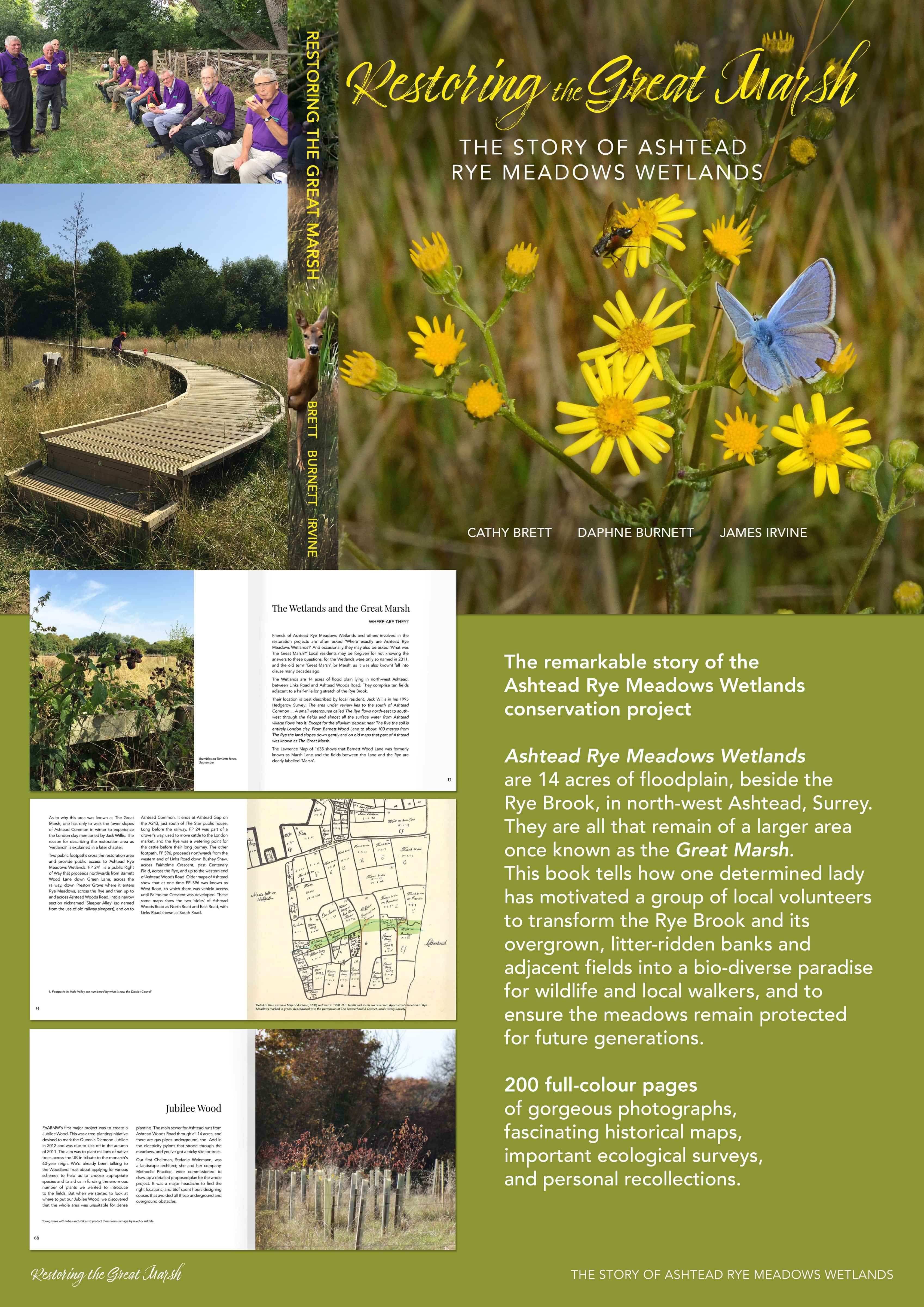
The lower area from the northern side of the Rye southwards, much of which is Flood Plain, forms part of a natural corridor along the Rye westwards from Ashtead Common. It has huge potential to provide a mosaic of habitats for many types of wild life and it is this area of approximately 14 acres which is the subject of a proposed long term environmental restoration and development project. To read more of the Great Marsh restoration project, a colour illustrated book has been published outlining how the project came about and how it has progressed over the years. See the details below. Some copies are still available and make a fascinating addition to the history of Ashtead.
Daphne Burnett
The present day
Since Daphne wrote the above piece she and her husband George have decided to pass the management of Rye Meadows to Surrey Wildlife Trust. They decided to give the 14 acres of Rye Meadows to the Trust and from 2025 the Trust has been managing the land with the continuing assistance of the Ashtead Rye Meadows Conservation Volunteers.
Although gifting the land, Daphne is still keeping a keen interest in the Meadows and she and George still generously allot a grant to the Volunteers each year to help with their finances.
"Restoring the Great Marsh" - Our story, now available.
Just in time for the 2022 Ashtead Village Day this book was published and brought for sale at the event. It sold very well, and everyone who looked at the book was impressed by the quality of the many photographs and the stories within.
The book's recommended retail price is £20 but the price has now been reduced to £10 for the remaining few copies. So, if you want a copy our advice is buy now because the book will not go into a second print. Daphne Burnett has stipulated that all proceeds are to be donated to Ashtead Rotary to continue their good works.
You can buy the book via the shop on this web site, and if you have an Ashtead Post Code, we will deliver free of charge. For other areas we can either calculate the cost of P&P, or you can call to collect. Email us to arrange.